Why Land Clearing + Grading + Planting Should Be One Plan
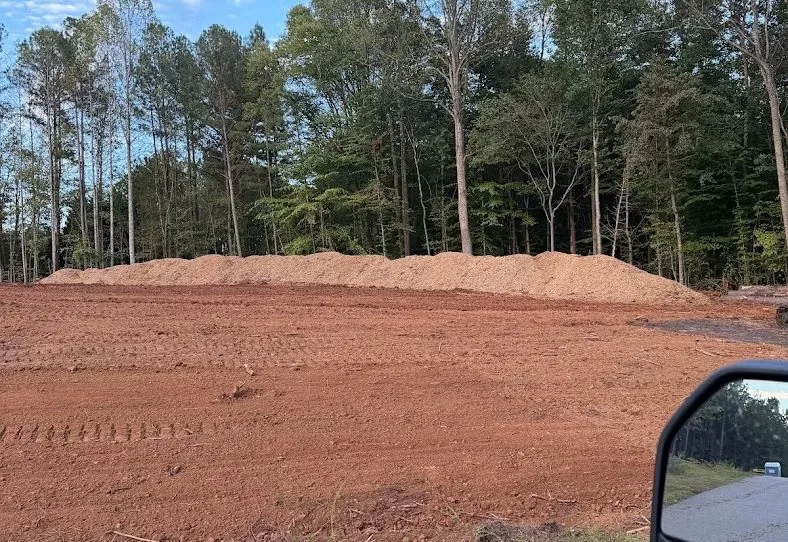
Need this done? See our Land Clearing NC services →
Here's how most land projects go: a clearing contractor clears the land, then leaves. Months later, a grading contractor comes in. Then a landscaper. Three separate crews, three separate scopes, three separate quotes — and usually at least one of them has to redo work because the previous crew didn't account for what came next.
There's a better way.
Why Separation Creates Problems
Clearing without a planting plan
When clearing doesn't account for what will be planted afterward, you lose trees and shrubs that would have been valuable to keep. A clearing crew with no planting context removes everything — including the mature dogwood in the corner that would have been the centerpiece of your landscape, or the creek bank willows that were doing most of the erosion control work.
Grading without drainage design
Grade without planning drainage, and you create slopes that drain to the wrong place. Add drainage without finalizing grade, and you install infrastructure that ends up in the wrong position relative to the finished surface. These mistakes require rework that wouldn't exist if both were designed together.
Planting without understanding the drainage
A planting plan that doesn't account for drainage conditions — wet spots, seasonal flooding zones, dry ridges — puts plants in the wrong places. Plants installed in areas that flood seasonally die. Areas that are dry need drought-tolerant species. Without drainage information built into the planting plan, you're guessing.
What a Unified Plan Looks Like
When we approach a complex project — land with clearing, grading, drainage, and landscape development needs — we treat it as a single design problem with interdependent parts:
- Site assessment first: Understand water movement, soil, existing vegetation value, and client goals before recommending anything.
- Clearing plan informed by the final landscape: Mark what to preserve, plan where mulch goes, identify trees that should stay because they're doing work.
- Grade designed for drainage, which is designed for planting: The finished grade creates the drainage patterns; the drainage system handles what grade can't; the planting plan uses native trees and groundcover to complete the water management picture.
- Phased installation that builds on itself: Clear, grade, drain, stabilize, plant — in sequence, each step creating the right conditions for the next.
The Result
Properties developed with this approach cost less than the sum of their disconnected parts — because there's no rework, no plant mortality from being put in the wrong conditions, and no drainage retrofits after the landscape is established. The finished property also functions better: drainage works with the plantings, the plantings reinforce the drainage, and the whole system improves over time as the plants mature.
We don't just clear land. We design land that works.
What the Disconnected Approach Actually Costs
It's hard to put an exact number on rework since every project is different, but the pattern is consistent: a drainage installer redoing work because grade shifted after they finished, a landscaper losing plants installed in a spot that turned out to flood, a grading crew cutting through a drain line nobody told them was there. Each of these is its own repair bill on top of the original scope — and in our experience, disconnected multi-contractor projects run measurably over budget compared to a single coordinated plan, simply from the accumulated cost of fixing handoff mistakes.
How to Evaluate a Contractor for This Kind of Project
If you're planning a project that touches clearing, grading, drainage, and planting, ask directly whether the contractor handles all of it or subcontracts pieces out to separate crews who don't coordinate. There's nothing wrong with subcontracting specialized work, but ask who owns the overall plan and who's responsible if something falls through the cracks between phases. A contractor who can walk you through how clearing decisions will affect the eventual planting plan — before any equipment shows up — is thinking about your project as a system, not a series of unrelated jobs.
One Crew. One Plan. Better Results.
We handle clearing through final landscape as a unified project. Free site assessment.
📞 Call (336) 967-4194Or Get a Free Estimate Online →