Why Most Yard Drainage Problems Start With Bad Grading
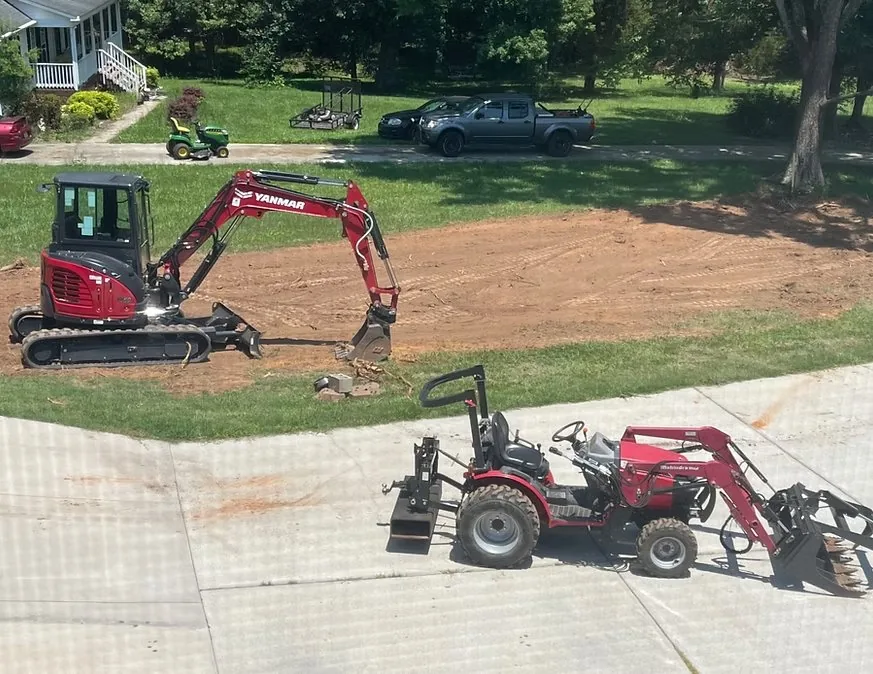
Need this done? See our Land Clearing & Grading services →
When homeowners call us about drainage problems, the first thing we check isn't the drainage — it's the grade. That's because in the majority of residential drainage cases we see in the Triad, the root cause is grading that's flat, settled, or reversed. The drainage problem is the symptom. The grade is the cause.
How Grade Controls Drainage
Water flows downhill. That's the whole principle of yard drainage. If your yard has the right slope — consistently moving water away from your house and toward an outlet — rain flows off cleanly and drainage infrastructure is needed only for edge cases and heavy events.
When grade is wrong, you're working against physics. You can install the most sophisticated French drain system in the county, but if the grade is pushing water toward a low spot faster than the drain can remove it, the low spot stays wet. Grade controls volume and direction. Drainage infrastructure handles the overflow.
Grade Fails First, Drainage Follows
Here's the typical progression we diagnose: the home was built with proper grade. Over 10–20 years, soil around the foundation settles 2–4 inches. What was a proper slope is now flat or slightly reversed. Water starts pooling in the flat area. The homeowner notices the wet spot and calls a contractor. The contractor installs a French drain in the wet spot — without fixing the grade.
The French drain helps at first. But because the grade is still flat, the drain is doing all the work that gravity should be doing. In a major rain event, it can't keep up. The wet spot is back. Now the homeowner has a wet spot AND a drainage system that isn't quite doing the job.
The Right Order of Operations
When we evaluate a drainage problem, we assess both grade and drainage infrastructure together. Our approach:
- Restore proper grade around the foundation and across problem areas first
- Install drainage infrastructure where grade alone isn't sufficient (heavy rain, clay soil, low-lying areas)
- Connect everything to a proper outlet
When you do it in the right order, the drainage infrastructure you install is appropriately sized for the actual problem — not oversized to compensate for a grade that's fighting against it.
How to Spot a Grade Problem Yourself
You don't need equipment to get a rough read on your own yard's grade. Stand at your foundation and look outward — does the ground visibly slope away, or does it look flat, or worse, tilt back toward the house? A simple check: after a heavy rain, walk the property and note exactly where water sits longest. Water pooling right against the foundation, or in a spot with no obvious downhill path to an outlet, is a strong sign the grade itself is the underlying issue rather than just a drainage capacity problem.
Why Foundation Settling Is So Common in the Piedmont
The clay soil that dominates this region expands when wet and contracts when dry — a cycle that happens every year, sometimes multiple times a season. That expansion and contraction is exactly what causes the gradual settling around foundations that flattens or reverses grade over a decade or two. It's not a sign anything was built badly; it's a predictable, near-universal consequence of building on clay in this climate. Which is also why a grading fix that was correct when the home was built often needs revisiting after 10–15 years, even without any dramatic event causing it.
What Regrading Actually Involves
Fixing settled grade around a foundation isn't always a massive undertaking. In many cases it means adding and properly compacting fill soil in the settled areas, reestablishing the target slope (typically a 6-inch drop over the first 10 feet away from the foundation), and re-stabilizing the surface with sod or seed once the grade is correct. For larger properties or more significant settling, it can involve broader regrading across multiple areas. Either way, it's almost always less invasive and less expensive than people expect — especially compared to the cost of the foundation or drainage problems that keep recurring if it's never addressed.
Grade and Drainage Working Together
We evaluate both in every assessment. Free on-site estimate for all Triad properties.
📞 Call (336) 967-4194Or Get a Free Estimate Online →