Sustainable Land Clearing: How to Clear Without Killing Your Soil
Need this done? See our Land Clearing NC services →
When you clear land with a bulldozer and haul everything off, you're not just removing trees and brush. You're removing 2–4 inches of topsoil, destroying the root networks that held moisture and nutrients, eliminating the organic matter that feeds soil microbes, and leaving exposed subsoil that erodes, compacts, and holds water poorly. What you plant on that scraped surface will struggle for years.
What Makes Clearing "Sustainable"
Sustainable land clearing preserves or restores the soil biology that makes land productive. The key principles:
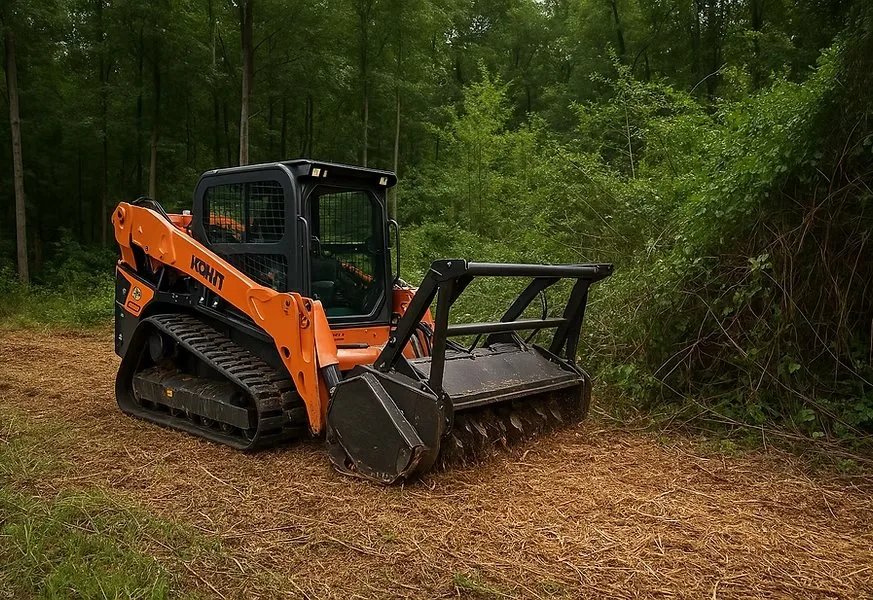
- Mulch in place, don't haul out: Forestry mulching returns all the organic matter back to the soil surface. It feeds microbes, retains moisture, and becomes topsoil over 12–24 months.
- Minimize soil disturbance: Smaller equipment footprints, fewer passes, and targeted clearing rather than full-area grubbing preserves soil structure.
- Selective clearing: Remove invasives and problem species while preserving native trees, beneficial shrubs, and root systems that hold soil.
- Immediate stabilization: Whatever you do clear, stabilize exposed soil immediately with seeding, mulching, or erosion blankets before the first rain.
The Forestry Mulching Advantage
Forestry mulching is the most practical sustainable clearing method available. The mulching head grinds everything to a 2–4 inch layer that sits on the soil surface. This layer: suppresses weed regrowth, prevents erosion in the first critical months after clearing, regulates soil temperature and moisture, and breaks down into organic matter that feeds the soil biology below.
Properties we mulch consistently establish vegetation faster and more successfully than traditionally cleared sites — because the soil hasn't been stripped.
Why Soil Biology Actually Matters Here
Healthy soil isn't just dirt — it's a living network of fungi, bacteria, and organic matter built up over decades. Mycorrhizal fungi, in particular, form partnerships with tree and plant roots that dramatically improve water and nutrient uptake. Strip the topsoil with a bulldozer and haul it off, and you're removing that entire network along with it. What's left is subsoil — compacted, low in organic matter, and largely biologically inactive. Anything planted there has to rebuild that soil ecosystem essentially from scratch, which is why traditionally cleared sites so often struggle with poor establishment, drainage problems, and stunted growth for years afterward.
The Long-Term Cost Nobody Budgets For
Scraped, compacted subsoil doesn't just look bad — it costs money down the line. Grass struggles to establish and needs more fertilizer and water to survive. Trees planted in stripped soil grow slower and are more prone to stress and disease. Drainage problems are more common because compacted subsoil doesn't absorb water the way intact topsoil does. Add up a few years of extra fertilizer, replacement plantings, and drainage fixes, and the "cheaper" traditional clearing approach often costs more in the long run than doing it sustainably from the start.
What Selective Clearing Looks Like in Practice
Selective clearing isn't an all-or-nothing choice between "clear everything" and "clear nothing." Before we start a project, we walk the property with you and mark what stays — mature native hardwoods, beneficial understory shrubs, anything with root systems already holding a slope in place. The mulching equipment works around those markers. You end up with cleared, usable land that still has the established trees providing shade, wind protection, and root-anchored soil stability exactly where you want to keep them.
Stabilizing Bare Ground Immediately
Any soil that does end up exposed — building pads, access paths, areas that get fully cleared — needs stabilization before the first hard rain, not weeks later. That means seeding with a fast-establishing cover crop, spreading straw or mulch, or installing erosion control blankets on slopes. In NC's Piedmont, a single heavy thunderstorm on bare clay soil can wash away inches of exposed ground and send sediment straight into nearby streams. A day or two of stabilization work upfront prevents that entirely.
Clear It Right the First Time
We build sustainability into every clearing project. Free estimate for Triad NC properties.
📞 Call (336) 967-4194Or Get a Free Estimate Online →