Land Clearing Doesn't Have to Destroy Nature — Here's How We Rebuild It
Need this done? See our Land Clearing NC services →
The standard narrative around land clearing is: you destroy what's there to make room for what you want. We think that's a limited way to look at it — and honestly, it leads to worse long-term results for your property.
Our approach: smart clearing replaces what it removes with native systems that manage water, restore soil, and bring wildlife back. The result is land that works better — not just land that's cleared.
What Gets Destroyed in Traditional Clearing (And Why It Matters)
A mature wooded acre contains: thousands of feet of root systems that manage groundwater and hold soil, 10–30 years of accumulated organic matter in the soil layer, habitat for dozens of bird and insect species, and a natural drainage system that absorbs and filters water before it reaches streams.
Strip it bare and you lose all of that. The land becomes prone to erosion, flooding, and invasive plant regrowth — requiring ongoing intervention to maintain.
The Rebuild Approach
Step 1 — Selective clearing: Remove invasive species, problem trees, and the growth that doesn't serve the property. Preserve native trees and understory plants wherever the project allows. Selective clearing creates open space without stripping the land of its natural infrastructure.
Step 2 — Mulch what you remove: Forestry mulching returns organic matter to the soil instead of hauling it off. The mulch layer feeds soil biology, suppresses invasive regrowth, and protects the soil during the transition period.
Step 3 — Restore with natives: Replant cleared areas with native NC trees and shrubs suited to your soil, drainage, and light conditions. Native plantings establish faster, require less maintenance, and restore the ecological functions of what was removed.
Step 4 — Address drainage properly: Use clearing and grading to create a drainage system that works with the natural landscape — not one that fights it. Native plants with deep root systems are often part of the drainage solution.
The Long-Term Difference
Properties managed this way require less ongoing intervention, have better drainage and soil health, support richer wildlife populations, and hold their value better than stripped, over-cleared parcels. It's not just the right thing to do — it's the smarter long-term investment.
What "Problem Growth" Actually Means
Not everything growing on a wooded property deserves to stay, and part of doing this right is knowing the difference. Invasive species like Chinese privet, kudzu, autumn olive, and English ivy actively crowd out the natives that provide real ecological value — removing them isn't destruction, it's restoration. We walk every property before clearing starts to identify what's invasive and should go, versus what's native and worth building the project around. That distinction is the difference between clearing that improves a property long-term and clearing that just removes whatever's easiest to remove.
A Real Example of the Approach
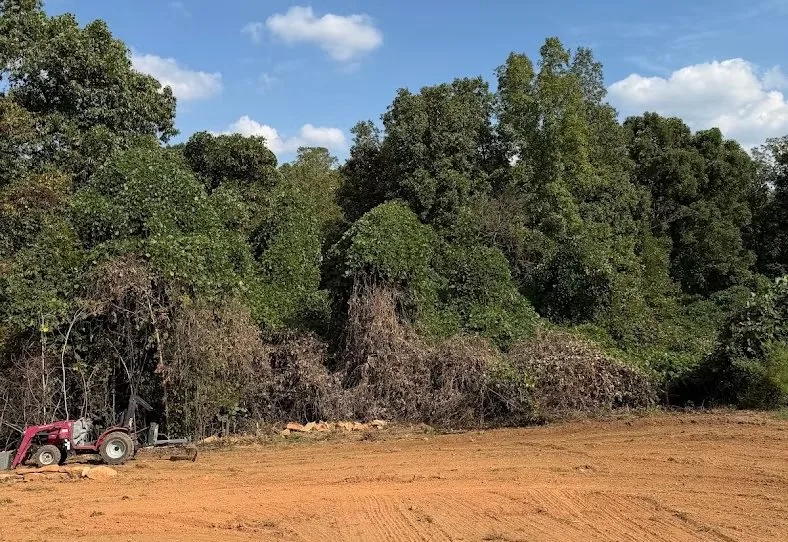
A typical overgrown residential lot might have a mix of mature oaks and hickories worth preserving, a dense privet hedge that's spread unchecked for years, and assorted vine growth choking out everything underneath. Our approach clears the privet and vines with forestry mulching, works carefully around the root zones of the oaks and hickories being preserved, and leaves the resulting mulch layer in place to protect the soil during the transition. What's left is open, usable land that still has established shade trees, healthier soil than a scraped lot would have, and none of the invasive species that would otherwise keep spreading.
Why This Approach Costs About the Same
A common assumption is that doing this "the right way" costs significantly more than a standard clear-cut. In practice, it usually doesn't — selective forestry mulching isn't inherently slower or more expensive than clearing everything indiscriminately, since the machine is doing similar work either way. The real cost difference shows up later: properties cleared this way need less remedial landscaping, less erosion repair, and less replanting from scratch, because so much of the property's natural infrastructure was preserved rather than destroyed and rebuilt from bare dirt.
Clear It Smart. Rebuild What Matters.
We design every clearing project to restore, not just remove. Free estimate for Triad NC.
📞 Call (336) 967-4194Or Get a Free Estimate Online →