Forestry Mulching vs. Traditional Land Clearing: Full Comparison
Need this done? See our Forestry Mulching services →
If you're planning to clear land, you'll encounter both options. Here's the complete, honest comparison — including cases where traditional clearing is actually the right call.
| Factor | Forestry Mulching | Traditional Clearing |
|---|---|---|
| Machines required | 1 | 3–4 (feller, chipper/burn, haul truck, stump grinder) |
| Speed | Faster on most jobs | Slower — multiple passes |
| Debris disposal | None — mulch stays on site | Significant haul-off cost |
| Soil impact | Low — mulch protects soil | High — bare soil exposed |
| Erosion risk after | Low | High — bare dirt erodes fast |
| Cost (typical) | Lower total cost | Higher — equipment + haul-off |
| Large trees (>10") | Less effective | Better for large timber |
| Building footprint prep | Requires additional grubbing | Can grub and grade in one pass |
| Timber value recovery | Destroyed | Timber can be sold |
| Environmental impact | Low | High — burning, hauling |
When Forestry Mulching Is Clearly Better
For the majority of residential and rural clearing jobs in NC, forestry mulching wins on cost, speed, and outcome. Specifically, it's the better choice when: the land will become lawn, garden, or natural landscape (not a building footprint); the growth is primarily brush, vines, and trees under 8 inches; debris haul-off would be required with traditional clearing; and environmental impact is a consideration.
When Traditional Clearing Makes More Sense
Traditional clearing earns its place in specific situations:
- Large valuable timber: Mature hardwoods (oak, walnut, hickory) have commercial value. A timber buyer can purchase standing timber before you clear — potentially offsetting a significant portion of your clearing cost. Forestry mulching destroys that value.
- Building footprint preparation: Construction requires full stump and root removal (grubbing). While forestry mulching can handle the surrounding areas, the building footprint usually needs traditional grubbing to remove all root systems from below grade.
- Very large trees: Trees over 10–12 inches diameter are challenging for mulching equipment and often better handled by a conventional tree service.
The Hybrid Approach
On many of our projects, we use both: forestry mulching for the areas outside the building footprint (future lawn and landscape), traditional grubbing for the building footprint itself. This gives you the cost and environmental benefits of mulching across most of the property, with the clean prep that construction requires in the critical area.
How Forestry Mulching Actually Works
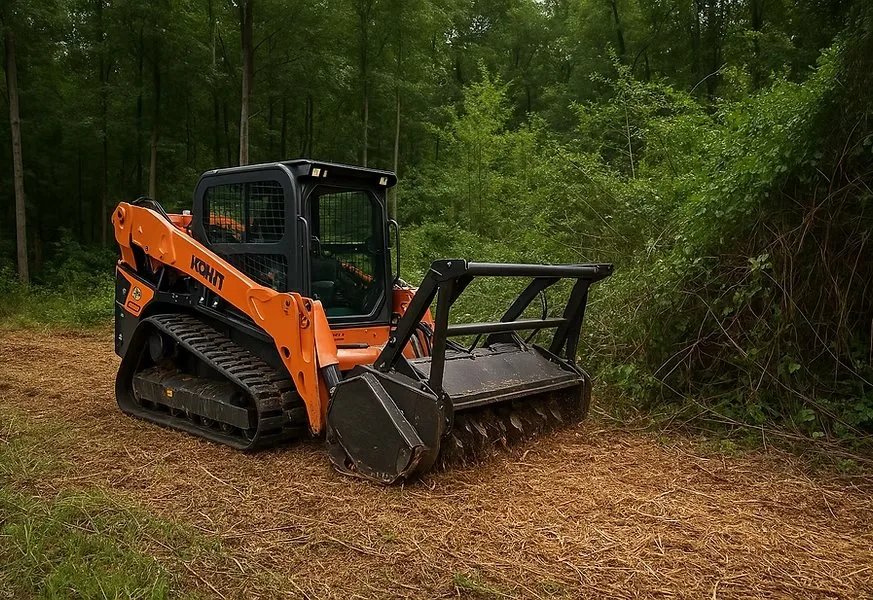
A forestry mulcher is a single tracked machine with a rotating drum head mounted on the front, fitted with carbide teeth. It drives directly over brush, saplings, and small trees, grinding everything — trunk, branches, leaves — into mulch in one pass. There's no separate cutting, hauling, or burning step. The machine that clears the land also disposes of the debris, which is the whole reason it's faster and cheaper than a multi-machine traditional approach.
A Real Cost Comparison
On a typical 2-acre residential lot with moderate brush and trees under 8 inches, forestry mulching usually runs somewhere in the $800–$4,000 range depending on density. The same job done traditionally — feller/cutting crew, a chipper or burn permit, a haul truck for debris — often runs 30–50% higher once you add up equipment rental or subcontracted hauling, disposal fees, and the extra labor hours across multiple machines and passes.
Timeline: Why Mulching Finishes Faster
Traditional clearing is sequential — cut, then pile or chip, then haul, then sometimes grade separately. Each step waits on the one before it. Forestry mulching collapses that into a single continuous pass across the property, which is why a job that might take a traditional crew 4–5 days often wraps in 1–2 days with mulching equipment. For time-sensitive projects, that difference alone can be the deciding factor.
What Happens to the Mulch Afterward
The ground-up material left behind isn't waste — it's a genuine soil amendment. Left in place, it suppresses weeds, retains moisture through NC's hot summers, and breaks down over 1–2 years into organic matter that improves the soil underneath. If you're planning to plant grass or landscaping soon after clearing, we can rake it thinner or remove excess in high-traffic areas; if the land's going to sit for a season before the next phase, leaving it in place actively protects the exposed soil from erosion in the meantime.
Not Sure Which Method Is Right for You?
We'll walk your property and tell you exactly which approach makes sense — and why.
📞 Call (336) 967-4194Or Get a Free Estimate Online →