How Much Mulch Do You Actually Need? (Simple Guide)
Need this done? See our Landscaping & Lawn Care services →
Mulch is sold by the cubic yard. Your garden beds are measured in square feet. The conversion is simple once you know it, and getting it right saves you money and extra trips to the landscape supply.
What Depth Do You Actually Need?
2 inches: Minimum effective depth. Provides some moisture retention but limited weed suppression. Requires replacement more frequently.
3 inches: The sweet spot for most applications. Effective weed suppression, good moisture retention, lasts 1.5–2 years before significant breakdown. This is what we recommend for most bed installations.
4 inches: Good for areas with heavy weed pressure or slopes where mulch displaces. Don't go deeper than 4 inches against tree trunks — thick mulch against bark creates moisture and disease problems.
Coverage by Common Purchase Size
- 1 cubic yard covers: 162 sq ft at 2", 108 sq ft at 3", 81 sq ft at 4"
- 2 cubic yards covers: 324 sq ft at 2", 216 sq ft at 3", 162 sq ft at 4"
- A full truckload (10 yards) covers: 1,620 sq ft at 2", 1,080 sq ft at 3", 810 sq ft at 4"
One Mistake Almost Everyone Makes
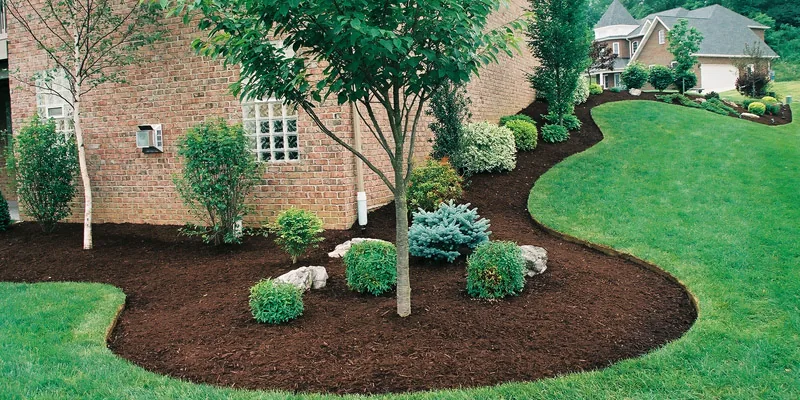
Piling mulch against tree trunks in a "mulch volcano." This traps moisture against the bark, promotes fungal disease, and creates habitat for insects that damage the tree. Keep mulch at least 3–4 inches away from the trunk, and keep it to 3 inches depth even at the outer edge of the drip line. Flat is better than volcano every time.
Measuring Irregular Beds Without Losing Your Mind
Most garden beds aren't clean rectangles, which is where people's math falls apart. The trick is to break an irregular bed into rough rectangles and circles, calculate each separately, then add them together. A curved border bed along a driveway, for example, might split into three or four rectangular chunks of roughly known width and length — you don't need to be precise to the inch, just close enough that your total order isn't off by a truckload.
For beds with a lot of curve to them, measure the widest point and the narrowest point, average the two, and multiply by the length. It won't be perfect, but it'll get you within 10–15% of the real number, which is plenty accurate for ordering mulch.
Bulk vs. Bagged: Where the Math Actually Matters
For anything over about 2 cubic yards, bulk delivery is almost always cheaper than bagged mulch from a home improvement store — often by half or more per cubic yard once you account for how many bags it takes to equal a yard (roughly 13–14 standard 2-cubic-foot bags). Bagged makes sense for small top-up jobs or beds you can't get a delivery truck close to. For a full property refresh, bulk is the right call almost every time.
One practical note: order 5–10% more than your calculated total. Beds settle unevenly during spreading, driveways and walkways eat up a bit of material during delivery, and running short mid-job means a second trip you didn't plan for.
Does Mulch Type Change How Much You Need?
Somewhat. Shredded hardwood settles and compacts over the season, so a 3-inch layer at installation might read closer to 2.5 inches by late summer — that's normal and part of why an annual or biannual top-up is standard, not a sign you did something wrong. Pine straw and pine bark nuggets hold their loft longer and don't compact as much, so they can sometimes get away with a slightly thinner initial layer for the same weed-suppression effect. If you're deciding between mulch types, that's a separate question from quantity, but it does shift the numbers a little.
A Real Example
Say you've got three garden beds: a 12×20 ft bed along the front foundation, a curved 8×15 ft bed around a tree island, and a narrow 3×40 ft border along a fence line. That's 240 + 120 + 120 = 480 square feet total. At 3 inches depth: 480 × 3 ÷ 324 = 4.4 cubic yards. Round up and order 5 yards to cover settling and spillage. That's the whole calculation — no guessing required.
We Handle Mulching Too
Professional mulch installation as part of full landscaping service. Free estimate.
📞 Call (336) 967-4194Or Get a Free Estimate Online →